



DPP-8
Dipeptidyl peptidase 8 (DPP-8) is an intracellular serine protease of the S9B family that cleaves N-terminal dipeptides from substrates containing a penultimate proline residue and is broadly expressed in mammalian tissues and immune cells[1]. DPP-8 participates in multiple biological functions, including immune regulation, cell proliferation, apoptosis, energy metabolism, and inflammatory responses, indicating a central role in maintaining cellular homeostasis[1][2]. Mechanistically, accumulating evidence places DPP-8 within inflammasome-associated pathways, where DPP8/9 activity suppresses inappropriate activation of innate immune signaling upstream of NLRP1-related responses[3][4]. In disease-relevant experimental systems, pharmacological inhibition of DPP8/9 activates inflammasome signaling and pyroptotic cell death in immune cells, highlighting the importance of DPP-8 in regulating inflammatory cell fate decisions[3][4]. Compared with the closely related isoform DPP-9, DPP-8 shares high structural and enzymatic similarity but appears to have partially distinct biological associations; available evidence suggests DPP-8 may be more closely linked to gut inflammation, whereas DPP-9 has stronger connections with antigen presentation and intracellular signaling pathways[2]. Therefore, distinguishing DPP-8 from DPP-9 remains important when interpreting experimental outcomes and designing mechanistic studies[2]. For experimental applications, selective DPP8/9 inhibitors have become valuable research tools for investigating inflammasome regulation, pyroptosis, immune-cell activation, and inflammatory disease mechanisms[1][3][4].
Références:
- [1]. Cui C, et al. New insights into the role of dipeptidyl peptidase 8 and dipeptidyl peptidase 9 and their inhibitors. Front Pharmacol. 2022;13:1002871.
- [2]. Zhang H, et al. Advances in understanding the expression and function of dipeptidyl peptidase 8 and 9. Mol Cancer Res. 2013 Dec;11(12):1487-96. [Content Brief]
- [3]. Johnson DC, et al. DPP8/9 inhibitors activate the CARD8 inflammasome in resting lymphocytes. Cell Death Dis. 2020 Aug 14;11(8):628. [Content Brief]
- [4]. de Vasconcelos NM, et al. DPP8/DPP9 inhibition elicits canonical Nlrp1b inflammasome hallmarks in murine macrophages. Life Sci Alliance. 2019 Feb 4;2(1):e201900313. [Content Brief]
All Product Categories
-
DPP-8 Produits associés (10)
Produits associés (10)

-
Anagliptin
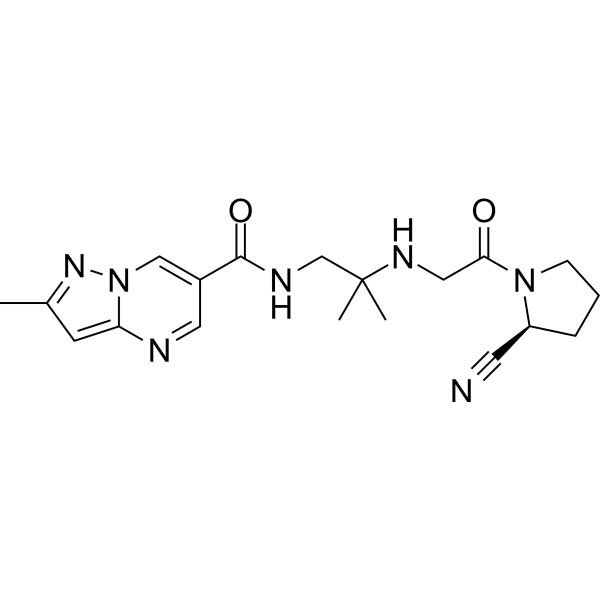 0 ImagesSynonyms: SK-0403Anagliptin (SK-0403) is a highly selective, potent, orally active inhibitor of dipeptidyl peptidase 4 (DPP-4), with an IC50 of 3.8 nM, and less selective at DPP-8 and DDP-9 with IC50s of 68 nM and 60 nM, respectively.
-
NZ-97
 0 ImagesCat. No.: HY-158315Pureté: 99.43%NZ-97 is a locally deliverable, lung-retaining dipeptidyl peptidase 4 (DPP4) inhibitor with an IC50 of 18 nM. It exhibits selectivity for DPP8 and DPP9 (with IC50 values of 1.3 μM and 0.6 μM, respectively). NZ-97 inhibits the DPP4 pool in lung-resident cells and epithelial lining fluid, elevates IL-6 and IGF-1 levels, and induces the expansion of type 2 alveolar epithelial cells (AEC2). NZ-97 reduces protein content in bronchoalveolar lavage fluid (BALF), ameliorates lung injury and alleviates pulmonary fibrosis. NZ-97 shows tolerability in untreated Mus musculus mice after intratracheal administration, and does not alter the proliferation or differentiation of lung fibroblasts. NZ-97 can be used in studies related to idiopathic pulmonary fibrosis, acute lung injury and emphysema.
-
Anagliptin hydrochloride
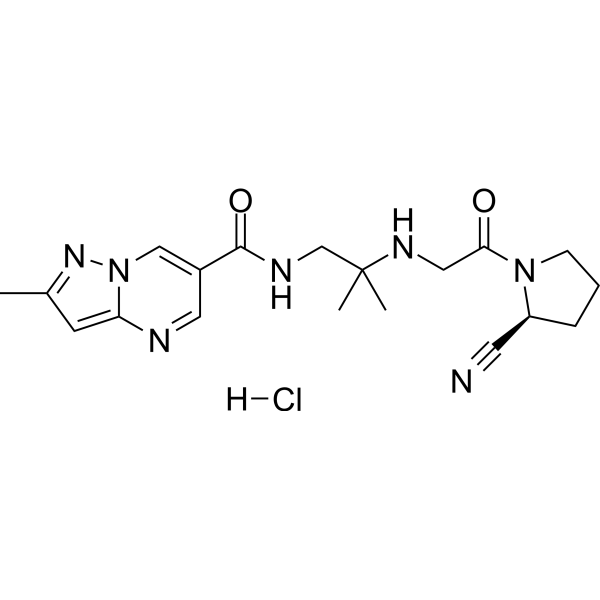 0 ImagesCat. No.: HY-14877ACAS No.: 1359670-56-6Synonyms: SK-0403 hydrochlorideAnagliptin (SK-0403) hydrochloride is a highly selective, potent, orally active inhibitor of dipeptidyl peptidase 4 (DPP-4), with an IC50 of 3.8 nM, and less selective at DPP-8 and DDP-9 with IC50s of 68 nM and 60 nM, respectively.
-
DPP-8/9 probe-1
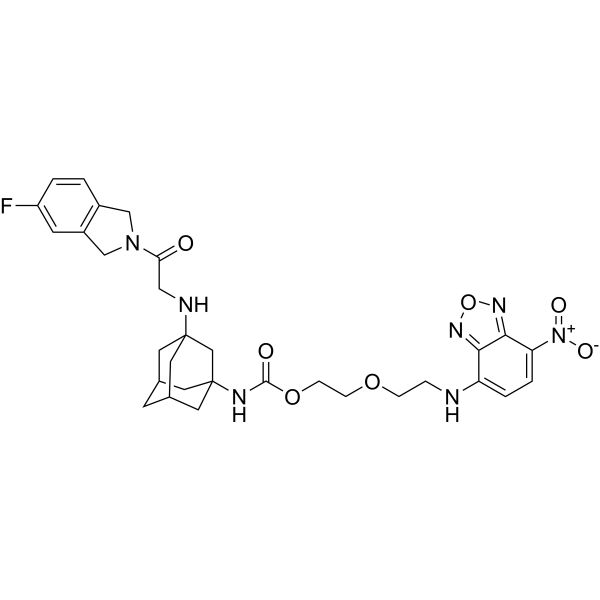 0 ImagesCat. No.: HY-D2327CAS No.: 3020859-80-4DPP-8/9 probe-1 (compound 20) is a fluorescent probe targeting Dipeptidyl Peptidase DPP8/9, which can be selectively labeled and visualized in vitro by fluorescence microscopy Active DPP8/9. DPP-8/9 probe-1 contains a nitrobenzoxadiazole (NBD) tag and has high affinity and selectivity for DPP8/9 over related S9 family members (IC50 of 210 nM and 15 nM, respectively).
-
5-Hydroxy saxagliptin hydrochloride
 0 ImagesCat. No.: HY-W741755A5-Hydroxy saxagliptin hydrochloride is an active metabolite of Saxagliptin (HY-10285) and a potent and selective DPP-4 inhibitor. 5-Hydroxy saxagliptin hydrochloride has Ki values of 2.6 nM and 2.9 nM for humans and cynomolgus monkeys, respectively. 5-Hydroxy saxagliptin hydrochloride can be used in the research of type 2 diabetes mellitus.
-
BMS-767778
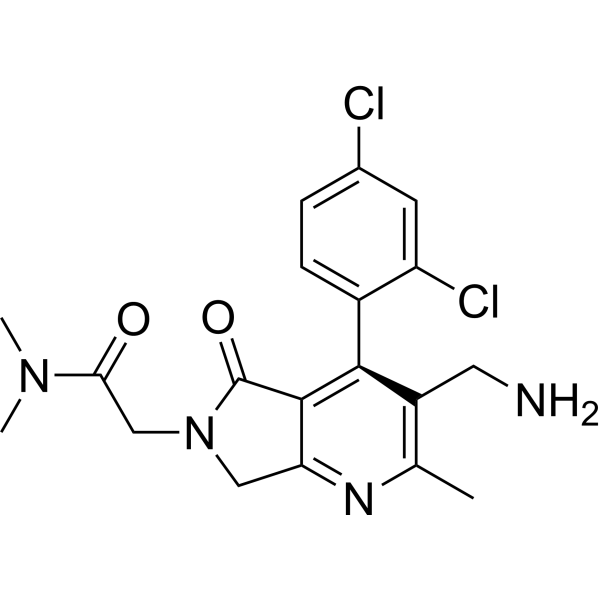 0 ImagesCat. No.: HY-16656CAS No.: 915729-95-2BMS-767778 is an orally active and selective DPP4 inhibitor with Ki values of 0.94 nM, 4.9, 3.2 nM for DPP4, DPP8 and DPP9 respectively. BMS-767778 exhibits >3,000-fold selectivity over the related enzymes DPP8 and DPP9. BMS-767778 inhibits CYP-3A4 with IC50 of 5.2 μM. BMS-767778 significantly reduces blood glucose levels in high fat fed (HFD) ob/ob mice with safety profile. BMS-767778 can be used for diabetes mellitus research.
-
DPP8/9-IN-1
 0 ImagesCat. No.: HY-176001DPP8/9-IN-1 (Compound 16) is a selective covalent inhibitor of dipeptidyl peptidases 8 and 9 (DPP8/9) with IC50 values of 14 and 298 nM, respectively. DPP8/9-IN-1 binds irreversibly to the active site serine (S730 in DPP9) via a phosphonate warhead and blocks substrate binding to inhibit DPP8/9-mediated protein processing. DPP8/9-IN-1 is promising for research of cancers and inflammatory diseases.
-
DPP9-IN-1
 0 ImagesCat. No.: HY-172529CAS No.: 3020859-03-1DPP9-IN-1 (Compound 42) is a dipeptidyl peptidase 9 (DPP9) inhibitor with IC50 of 3 nM for DPP9 and 0.6 μM for DPP8. DPP9-IN-1 induces concentration-dependent LDH release in THP-1 cells.
-
cis-ICeD-2
 0 ImagesCat. No.: HY-151871Acis-ICeD-2 is the cis isomer of ICeD-2 (HY-151871). ICeD-2 is a cell death inducer that induces cell death in HIV-1-infected cells. ICeD-2-mediated killing of HIV-1-infected cells is dependent on HIV-1 protease activity. ICeD-2 effectively blocks the hydrolysis of Gly-Pro-AMC by the dipeptidyl peptidases DPP8 and DPP9. ICeD-2 demonstrates strong stability against DPP9 in PBMCs..
-
DPP8/9-IN-2
 0 ImagesCat. No.: HY-175226CAS No.: 3109603-86-0DPP8/9-IN-2 (Compound 21) is a DPP8/9 inhibitor with IC50 values of 0.22 nM and 3 nM, respectively, and Ki values of 2.9 nM and 6 nM, respectively . DPP8/9-IN-2 has certain cardiotoxicity, with IC50 values of 0.7 μM, 29.0 μM and 27.7 μM for hERG potassium channel, Nav1.5 sodium channel and Cav1.2 calcium channel, respectively. DPP8/9-IN-2 can be used in the research of diseases such as tumors.



